Porsche Mission X: Redefining the Hypercar Through Precision, Not Excess
Porsche has never chased spectacle for its own sake. While other manufacturers shout about horsepower wars and record-breaking theatrics, Porsche operates differently – quietly, methodically, and with devastating effectiveness.
From the 959 to the Carrera GT and the 918 Spyder, Porsche’s halo cars haven’t just been fast – they’ve rewritten what performance means. Each one introduced new technology, new thinking, and new standards the rest of the industry was forced to follow.
The Porsche Mission X is expected to continue that lineage, not as a nostalgic throwback or an electric experiment, but as a bold statement: that the future of hypercars can still be driven by engineering purity, even in an electric era.
Mission X isn’t about replacing the past.
It’s about redefining dominance for what comes next.
Design: Purpose Over Drama
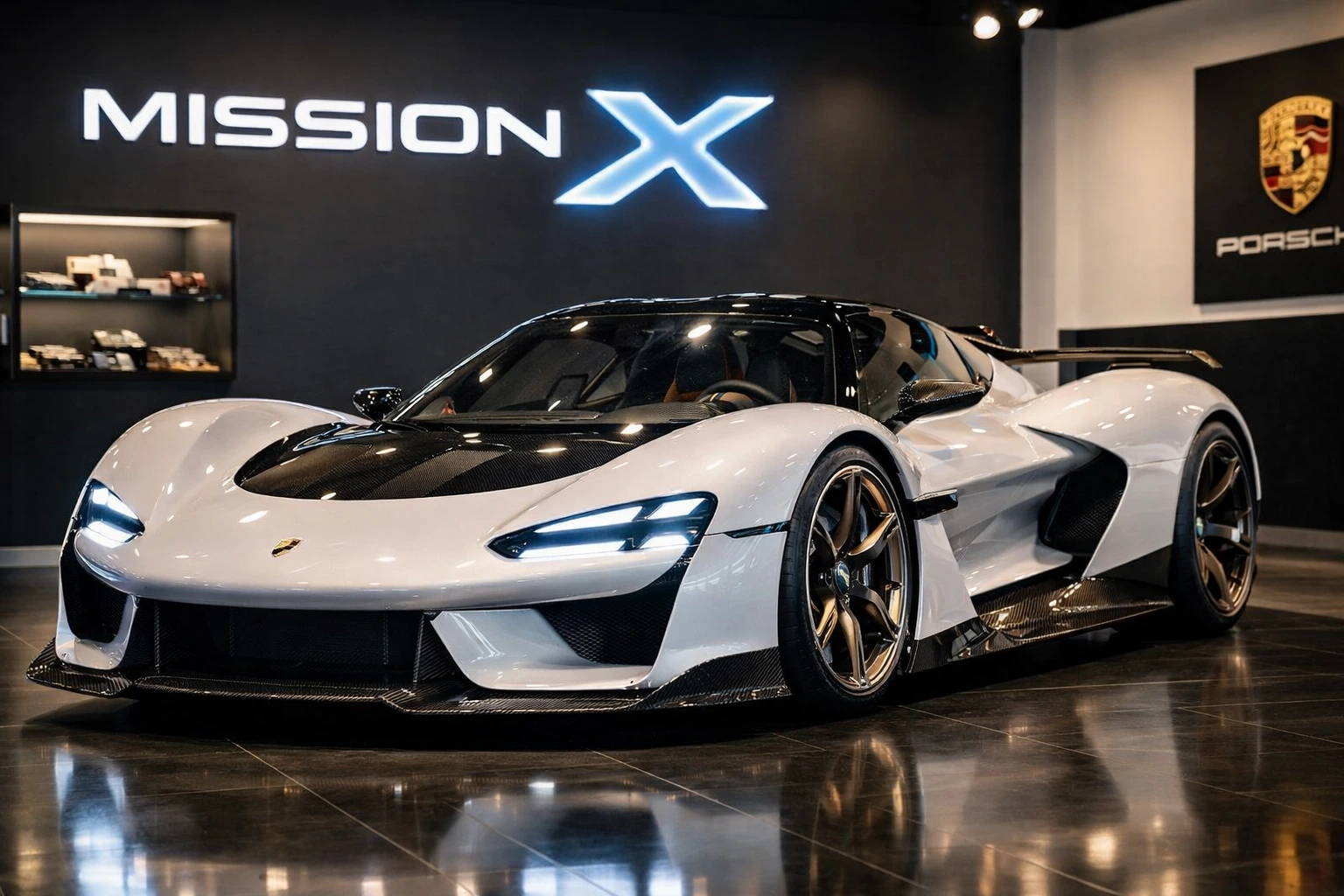
At first glance, the Mission X looks radical – but look closer, and it’s unmistakably Porsche.
There’s no unnecessary aggression, no theatrical wings or visual noise. Instead, the design communicates intent with clarity. Every line, intake, and surface exists to serve airflow, cooling, or stability.
Expected design highlights:
- Ultra-low stance with compact, muscular proportions
- Le Mans–inspired canopy and dramatic butterfly doors
- Integrated active aerodynamics rather than fixed aero clutter
- Clean surfacing guided by efficiency, not shock value
- Extensive use of lightweight materials and structural optimization
Where many electric hypercars lean into sci-fi aesthetics, Mission X feels engineered, not styled. It looks like the result of simulations, CFD data, and track testing – not mood boards.
If the 918 Spyder blended beauty with technology, Mission X strips that idea down to its purest form.
Interior: Focused, Technical, Intentionally Sparse
Porsche interiors have always prioritized the driver, and Mission X is expected to take that philosophy further than any road-going Porsche before it.
Luxury is present – but only where it enhances the driving experience.
Expected interior experience:
- Driver-centric cockpit with minimal distractions
- Lightweight bucket seats inspired by endurance racing
- Carbon-fiber structural elements left intentionally exposed
- Compact digital displays providing only essential information
- Race-derived ergonomics with an emphasis on control and visibility
This is not a grand tourer.
This is a control room.
Every interface is designed to reduce cognitive load at speed, allowing the driver to focus entirely on placement, braking, and acceleration. Comfort exists – but it never compromises feedback.
Mission X isn’t built to pamper its occupants.
It’s built to make them faster.
Also Read : apollo-evo-a-modern-hypercar-built-without-fear
Powertrain & Performance: Electric, But Unapologetically Porsche
Mission X is expected to be fully electric, but calling it an “EV hypercar” undersells Porsche’s ambition.
This isn’t about sustainability messaging or silent cruising. It’s about harnessing electric power to achieve performance targets that internal combustion simply can’t match anymore.
Expected powertrain philosophy:
- High-output electric motors with instant torque delivery
- Advanced battery system optimized for power density and cooling
- Rear-biased or performance-focused all-wheel-drive system
- Energy deployment tuned for track endurance, not range
Estimated performance goals (as rumored):
- Power-to-weight target of 1 hp per kilogram
- 0–100 km/h (0–62 mph): under 2.5 seconds
- Nürburgring lap times targeting class-leading benchmarks
- Advanced 800–900V architecture for sustained performance
Unlike many EVs that feel brutally fast but emotionally distant, Porsche’s challenge is feel – and that’s where Mission X is expected to excel.
Throttle mapping, torque vectoring, and chassis integration will be calibrated to deliver precision, not just acceleration.
Electric doesn’t mean soulless.
Not when Porsche is involved.
Driving Experience: Precision as Performance
If there’s one thing Porsche understands better than almost anyone, it’s how a car should communicate.
Mission X is expected to embody that philosophy, even without an engine soundtrack.
Expected driving characteristics:
- Extremely low center of gravity due to battery placement
- Immediate, linear power delivery with predictable response
- Steering tuned for feedback, not artificial weighting
- Advanced suspension balancing compliance and track sharpness
- Active aerodynamics adjusting dynamically to driving conditions
Where some hypercars overwhelm drivers with sheer violence, Porsche traditionally builds confidence through balance and clarity. Mission X should feel devastatingly quick – but never chaotic.
This is a car designed to reward precision, not bravery.
Technology & Innovation: Invisible Until It Matters
Porsche has always believed that the best technology disappears in use. Mission X is expected to be a rolling demonstration of that philosophy.
Key innovations expected:
- Next-generation lightweight chassis architecture
- Advanced thermal management for sustained track use
- Intelligent torque vectoring and energy deployment
- Active aero and suspension working seamlessly in the background
- Software developed with motorsport-grade logic, not gimmicks
Nothing here exists for headlines.
Everything exists to shave seconds, increase stability, or enhance control.
Positioning: The Engineer’s Hypercar
Mission X isn’t trying to be the loudest or most exclusive hypercar on the planet.
It’s aiming to be the most correct.
Its natural rivals include:
- Ferrari’s next hybrid/electric flagship
- Rimac Nevera and its successors
- Future electric performance hypercars
But, like every great Porsche, its real benchmark is internal – the legacy of the 959, Carrera GT, and 918 Spyder.
Mission X doesn’t ask for attention.
It earns respect.
Pros & Cons
✅ Pros
- Porsche’s unmatched chassis and engineering expertise
- Electric performance without sacrificing driver engagement
- Clean, purposeful design
- Potential Nürburgring dominance
- Future-proof performance philosophy
❌ Cons
- Electric powertrain may alienate traditionalists
- Likely extremely limited production
- High price point
- Less emotional drama compared to ICE hypercars
Who Is the Porsche Mission X For?
Mission X is built for:
- Drivers who value precision over spectacle
- Engineers at heart
- Enthusiasts who believe feel matters more than noise
- Those who understand that performance is about control, not chaos
Also Read : gordon-murray-automotive-t-33-the-supercar-that-rejects-excess
Final Thought
The Porsche Mission X isn’t about proving electric cars can be fast.