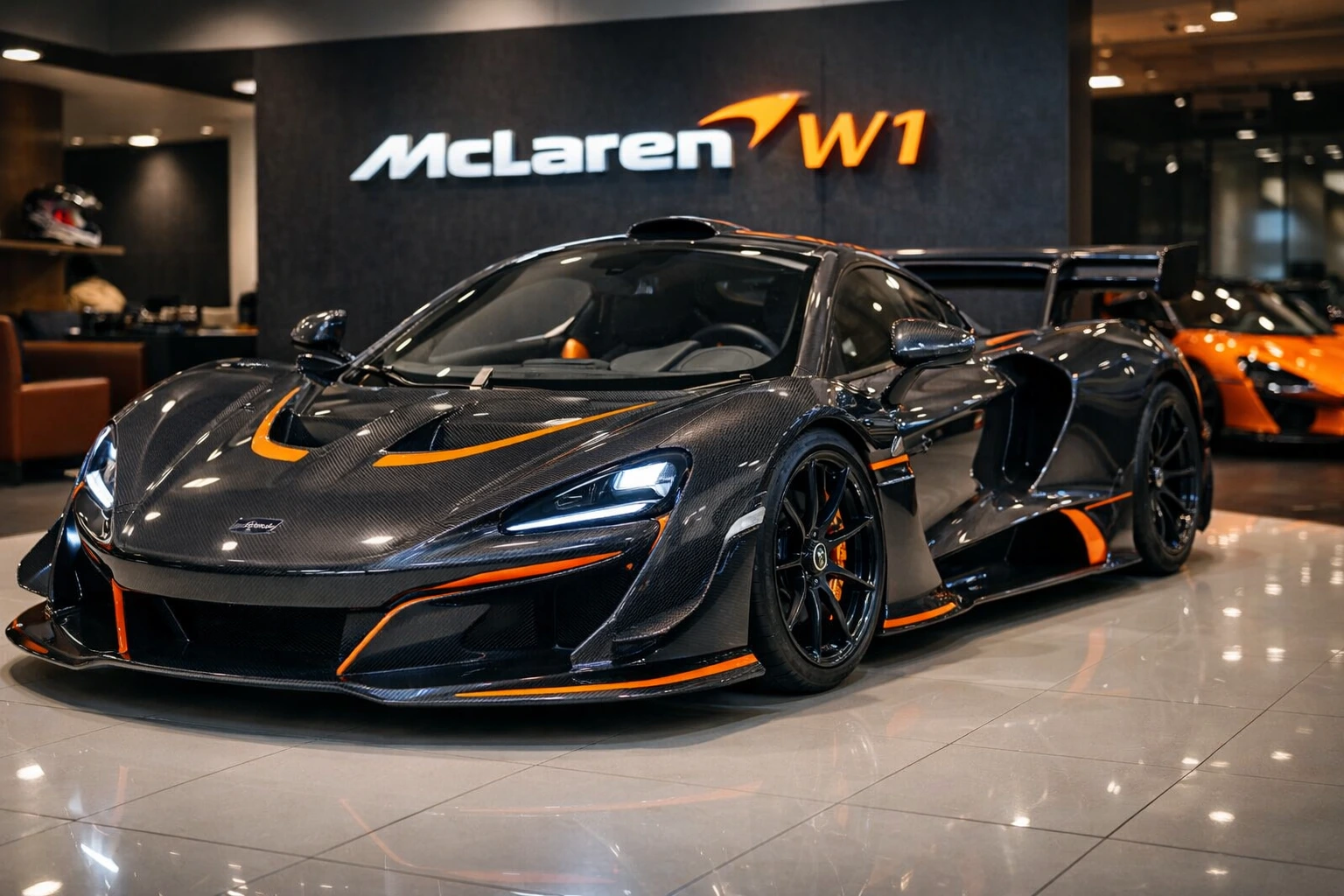
McLaren W1: The Next Chapter in McLaren’s Hypercar Legacy
McLaren doesn’t build cars to impress on paper – it builds them to dominate physics. From the F1 to the P1 and Speedtail, every McLaren halo car has pushed boundaries not just of speed, but of engineering philosophy.
The McLaren W1 is expected to continue that lineage as the brand’s next flagship hypercar. Positioned above the current Super Series and potentially alongside or beyond the Speedtail in ambition, the W1 represents McLaren’s vision of the future: extreme performance powered by hybrid intelligence, wrapped in unmistakable McLaren DNA.
Design: Minimalism at Maximum Speed
McLaren design has always been about efficiency, not decoration – and the W1 is expected to push that philosophy further than ever.
Unlike hypercars that rely on visual shock value, the W1 will likely appear deceptively clean. Every surface exists for a reason: airflow, cooling, or downforce.
Expected design highlights:
- Ultra-low, cab-forward proportions
- Aggressive active aerodynamics integrated seamlessly into the body
- Sculpted side intakes and underbody venturi tunnels
- Lightweight carbon-fiber construction throughout
The W1 won’t scream for attention – it will command it through intent. This is a car shaped by wind tunnels and race telemetry, not styling trends.
If the P1 looked like the future in 2013, the W1 is expected to look like it arrived from a decade ahead.
Interior: Formula 1 Philosophy, Road-Car Precision
Inside, the McLaren W1 is expected to remain unapologetically driver-focused.
McLaren has never chased luxury for luxury’s sake, and the W1 won’t change that. Instead, it will deliver a cockpit that feels like an extension of the driver’s nervous system.
Expected interior experience:
- Minimalist layout with digital driver display
- Lightweight carbon-fiber tub and exposed structural elements
- Alcantara, carbon, and precision-machined controls
- Formula 1–inspired seating position
Every gram matters. Every button exists for a reason. Comfort is present – but never at the expense of focus.
This is a cockpit designed to make the driver faster, not more relaxed.
Powertrain & Performance: Hybrid Intelligence, McLaren Style
At the heart of the W1 is expected to be a next-generation hybrid powertrain, combining McLaren’s expertise in turbocharged engines with advanced electric assistance developed through years of Formula 1 hybrid experience.
Expected powertrain configuration:
- High-revving twin-turbo V8
- Lightweight electric motor for instant torque and response
- Advanced battery system optimized for performance, not range
- Rear-wheel drive or advanced performance-focused drivetrain
Estimated performance targets:
- Combined output: 1,200+ horsepower (rumored)
- 0–100 km/h (0–62 mph): ~2.5 seconds
- Top speed: 350 km/h+ (217+ mph)
Short electric-only capability for low-speed driving
This hybrid system isn’t about efficiency – it’s about precision. Electric torque fills gaps, sharpens throttle response, and enhances corner exit speed, while the V8 delivers the emotional punch McLaren fans expect.
The result should be relentless acceleration with surgical control.
Also Read : apollo-evo-a-modern-hypercar-built-without-fear
Driving Experience: The Purest Form of Control
McLaren’s defining trait has always been how its cars feel at the limit – light, communicative, and brutally effective.
The W1 is expected to elevate that experience to hypercar levels.
Expected driving characteristics:
- Exceptionally low weight for a hybrid hypercar
- Hyper-responsive steering and chassis feedback
- Active aerodynamics adapting in real time
Drive modes ranging from road compliance to track domination
Unlike hypercars that intimidate, McLarens traditionally build confidence through clarity. The W1 should feel devastatingly fast without feeling unpredictable.
This is a car designed to reward skill – not punish mistakes.
Technology & Innovation
The McLaren W1 will act as a rolling showcase of the brand’s most advanced technology.
Key innovations expected:
- Next-generation carbon-fiber monocoque
- Advanced hybrid energy deployment systems
- Active suspension and aerodynamic management
- Extreme weight-saving measures across all components
McLaren’s philosophy remains unchanged: technology should be invisible until it’s needed – then transformative.
Positioning: The Driver’s Hypercar
Where some hypercars chase exclusivity or luxury, the W1 is expected to chase lap times, engagement, and purity.
It will likely compete with:
- Ferrari’s next hybrid flagship
- Aston Martin Valhalla and Valkyrie derivatives
- Future limited-production hybrid hypercars
But the W1’s true competition is internal – living up to the legacy of the McLaren F1 and P1.
Pros & Cons
✅ Pros
- Extreme hybrid performance with lightweight focus
- McLaren’s unmatched chassis and steering feel
- Clean, functional design
- Formula 1–inspired technology
❌ Cons
- Extremely limited availability
- High price point
- Less luxury-focused than some rivals
Who Is the McLaren W1 For?
The W1 is built for:
- Drivers who value feel over flash
- Collectors who appreciate engineering purity
- Enthusiasts seeking the most engaging hypercar possible
- Those who believe speed is meaningless without control
Final Thought
The McLaren W1 isn’t about breaking records for headlines. It’s about pushing the relationship between driver and machine to its absolute limit.